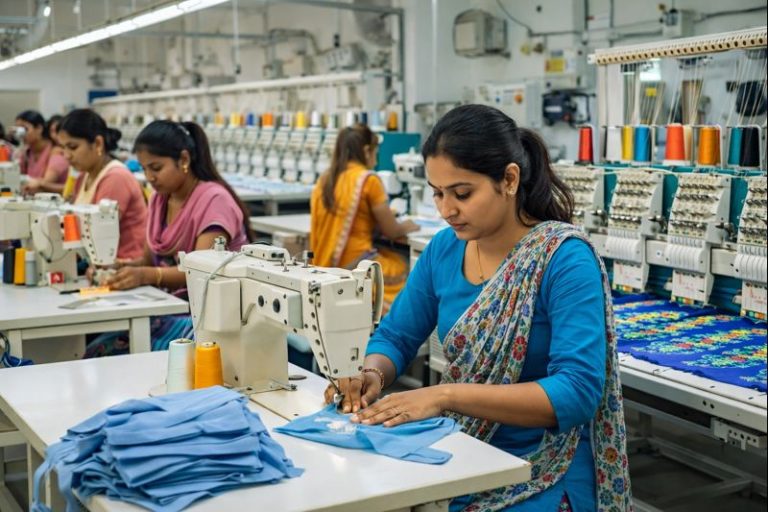
The Gujarat government has introduced important amendments to the Gujarat Textile Policy 2024 with the goal of promoting women’s economic empowerment and extending benefits to non-polluting textile units operating within municipal areas. The revised policy is designed to create wider opportunities in the textile sector while ensuring environmentally responsible industrial growth.
Major Policy Changes Approved by Chief Minister Bhupendra Patel
Focused Support for Women Self-Help Groups
Under the leadership of Chief Minister Bhupendra Patel, the state has approved reforms that place strong emphasis on the income growth of women-led Self-Help Groups (SHGs) in both rural and urban regions. For the first time, the policy introduces a structured mechanism to strengthen women’s participation in textile-based livelihood activities.
The updated provisions allow one or more women-led SHGs engaged in similar economic activities to receive assistance under the textile policy. This step is expected to encourage collective entrepreneurship and improve financial stability among women.
Who Is Eligible?
As per the revised guidelines:
-
SHGs registered under the National Rural Livelihood Mission (NRLM)
-
Groups under the National Urban Livelihood Mission (NULM)
-
Recognized voluntary women SHGs
will now be eligible to access incentives and support under the Gujarat Textile Policy 2024.
Benefits Extended to Urban Non-Polluting Textile Units
Inclusion of Municipal Area Enterprises
Another key amendment expands policy coverage to non-polluting textile manufacturing units located inside municipal limits. Businesses involved in:
-
garments and apparel manufacturing
-
stitching and embroidery
-
made-ups and allied textile activities
can now qualify for government incentives, provided they fall under the White or Green category as defined by the Gujarat Pollution Control Board.
Boost to Employment and MSME Growth
Policy experts believe these reforms will:
-
generate new urban employment opportunities
-
support micro, small and medium enterprises (MSMEs)
-
improve the use of existing city infrastructure
-
reduce production costs and increase competitiveness
Labour-intensive segments such as stitching, tailoring, and embroidery are largely concentrated in cities. The new provisions are expected to offer local job access for women, promoting better work-life balance and long-term socio-economic security.
Sustainable and Inclusive Textile Development
The amendments also highlight Gujarat’s commitment to environmentally responsible industrialization. By supporting only non-polluting manufacturing practices, the government aims to balance economic growth with ecological protection.
The inclusion of women SHGs is being viewed as a landmark step toward women’s financial independence and greater participation in business and industry. The reforms, guided by Chief Minister Bhupendra Patel and Deputy Chief Minister & Industries Minister Harsh Sanghavi, are expected to strengthen Gujarat’s position as a leading textile hub in India.
Conclusion
The revised Gujarat Textile Policy 2024 marks a progressive move toward women empowerment, urban employment generation, and sustainable textile growth. By bringing SHGs and municipal textile units under its framework, the state is building a more inclusive and competitive textile ecosystem aligned with India’s economic development goals.